
The ICC Women’s T20 World Cup 2026 in England and Wales is set to become a historic milestone for the global women’s game. While much of the spotlight naturally falls on traditional powerhouses such as Australia, England, and India, one of the tournament’s most compelling stories belongs to a nation better known for football, windmills, and tulips.
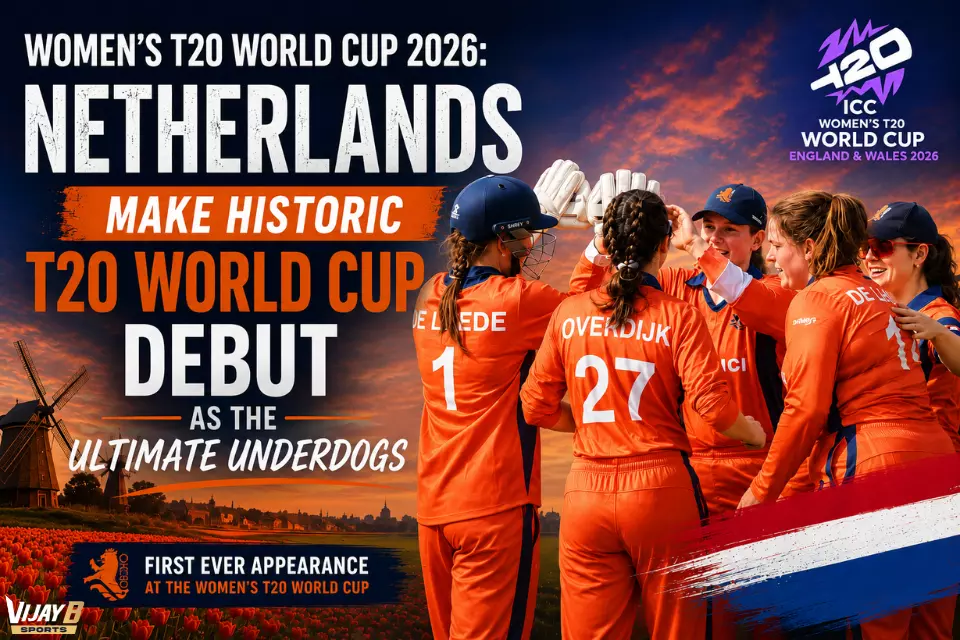
Against the odds, the Netherlands Women’s Cricket Team has secured qualification for the ICC Women’s T20 World Cup for the very first time. Their breakthrough marks a major achievement for Dutch cricket and highlights the growing competitiveness of women’s cricket beyond its traditional strongholds.
This milestone is not only a proud moment for the Netherlands but also one of the most inspiring underdog stories in women’s cricket. As the Women’s T20 World Cup 2026 approaches, the Dutch side will have an opportunity to test themselves against the world’s best teams on the sport’s biggest stage.
The Historic Breakthrough: How the Dutch Reached Their First Women’s T20 World Cup
For decades, women’s international cricket has largely been dominated by established Full Member nations such as Australia, England, India, and New Zealand. For an Associate nation like the Netherlands, where cricket remains a minority sport, reaching a major ICC tournament has long been a difficult challenge.
The breakthrough came during the ICC Women’s T20 World Cup Qualifier campaign. Facing intense pressure throughout the qualification process, the Dutch side consistently delivered disciplined performances with both bat and ball. Their decisive victory over the United States ultimately secured qualification and confirmed their place in the Women’s T20 World Cup 2026.
The celebrations that followed reflected the significance of the achievement. Players and coaching staff understood they had created history by earning the Netherlands’ first-ever appearance at a Women’s T20 World Cup.
By qualifying, the Netherlands joined Bangladesh, Ireland, and Scotland as the teams that successfully progressed through the qualification pathway into the expanded 12-team tournament. Their achievement represents years of development work and demonstrates the continued growth of women’s cricket across Europe.
Why the Netherlands Could Be a Dangerous Underdog
Many observers may view the Netherlands as tournament outsiders, but dismissing the Dutch women as merely making up the numbers would be a mistake. Their biggest strength is the freedom that comes from entering the tournament with minimal expectations. Without the burden of title pressure, they can play aggressively, take tactical risks, and challenge stronger opponents with a fearless mindset.
In T20 cricket, momentum can shift rapidly. A strong powerplay, an early breakthrough with the ball, or a quick-fire batting partnership can completely change the direction of a match. The Dutch squad understands this reality and will look to maximize key moments rather than rely on overwhelming depth.
Another possible advantage is the playing conditions. English pitches often assist seam bowlers early in the innings, and several Dutch bowlers are comfortable in conditions that reward accuracy, movement, and disciplined line-and-length bowling. If higher-ranked teams underestimate the Netherlands, they may find themselves under pressure much sooner than expected.
Key Players Behind the Dutch Rise
Babette de Leede – Leading from the Front
Captain Babette de Leede has been one of the most influential figures in Dutch women’s cricket. As both a wicketkeeper and top-order batter, she provides leadership, experience, and composure during pressure situations.
Her ability to guide younger players while contributing important runs makes her one of the most valuable members of the squad. The Netherlands will rely heavily on her calm decision-making throughout the tournament.
Sterre Kalis – The Batting Backbone
Sterre Kalis is widely regarded as one of the most technically accomplished batters in Dutch cricket. Having gained experience in various international competitions, she plays a crucial role in stabilizing the innings and building partnerships.
Against elite bowling attacks, her ability to rotate strike and maintain scoreboard pressure could prove invaluable.
Frédérique Overdijk – The All-Round Asset
Every successful T20 team needs players who can contribute in multiple areas, and Frédérique Overdijk provides exactly that balance.
Her versatility allows the Netherlands to adjust their tactical plans depending on match situations. Whether contributing valuable middle-order runs or delivering important overs, she offers flexibility that every underdog team requires.
Isabel van der Woning – New-Ball Threat
Fast bowler Isabel van der Woning could become one of the Netherlands’ most important weapons in English conditions.
Her ability to generate movement with the new ball gives the Dutch attack an opportunity to challenge opposition batters early. If she can strike during the powerplay, the Netherlands may create opportunities to put stronger teams under immediate pressure.
The Challenge Ahead in Group A
The Netherlands face a difficult assignment in Group A, where they will compete against Australia, India, South Africa, Pakistan, and Bangladesh.
Australia enter the tournament as one of the favourites and possess exceptional depth across both batting and bowling departments. India continue to strengthen their status as a major force in women’s cricket, while South Africa have developed into a consistent contender in ICC tournaments.
Pakistan and Bangladesh also bring significant international experience and understand the demands of major global events.
Although the group presents a formidable challenge, it also provides the Netherlands with an opportunity to accelerate their development by competing against some of the best players in the world. Every match offers valuable experience and the chance to create memorable upsets.
What the Dutch Breakthrough Means for Global Cricket
The Netherlands’ qualification extends far beyond one tournament.
Their success serves as evidence that women’s cricket is becoming increasingly competitive across a wider range of nations. It demonstrates that long-term investment, structured development pathways, and international opportunities can help Associate nations close the gap on traditional cricket powers.
This progress is particularly important as cricket prepares for its return to the Olympic Games at Los Angeles 2028. A broader and more competitive international landscape will only strengthen the sport’s global appeal.
The Dutch achievement also provides inspiration for emerging cricket nations such as Thailand, Nepal, and the United Arab Emirates, proving that qualification for major ICC events is becoming a realistic goal rather than a distant dream.
Conclusion
Regardless of where the Netherlands ultimately finishes in the Women’s T20 World Cup 2026 standings, their qualification has already become a landmark moment for Dutch cricket. Their journey from Associate nation to World Cup participant represents determination, development, and belief, while also highlighting the continued growth of women’s cricket around the world.
As the Oranje prepare for their historic debut on some of England’s most iconic cricket grounds, they carry the hopes of every emerging nation eager to compete on the biggest stage.
💡 Follow vijaybsport for the latest Women’s T20 World Cup 2026 updates, match previews, and cricket insights.

FAQ: Women’s T20 World Cup 2026 Netherlands Squad
Because this is the Netherlands Women’s first-ever appearance at the ICC Women’s T20 World Cup, marking a major breakthrough for Dutch cricket.
The Netherlands are in Group A with Australia, India, South Africa, Pakistan, and Bangladesh.
Yes. Although they are underdogs, their disciplined bowling, fearless mindset, and experience in European conditions could trouble stronger teams.