


India pulled off their highest successful run chase in men’s T20I cricket to beat New Zealand in a thrilling series opener. Chasing 226, the visitors reached 230/6 with two balls to spare, winning by four wickets and taking a 1–0 lead in the five-match series.
Sanju Samson set up the chase with an attacking half-century before Naman Dhir delivered a match-winning finish. Between those two performances, India had to survive a middle-order wobble that briefly put New Zealand back in control.
India vs New Zealand 1st T20I: Match Score
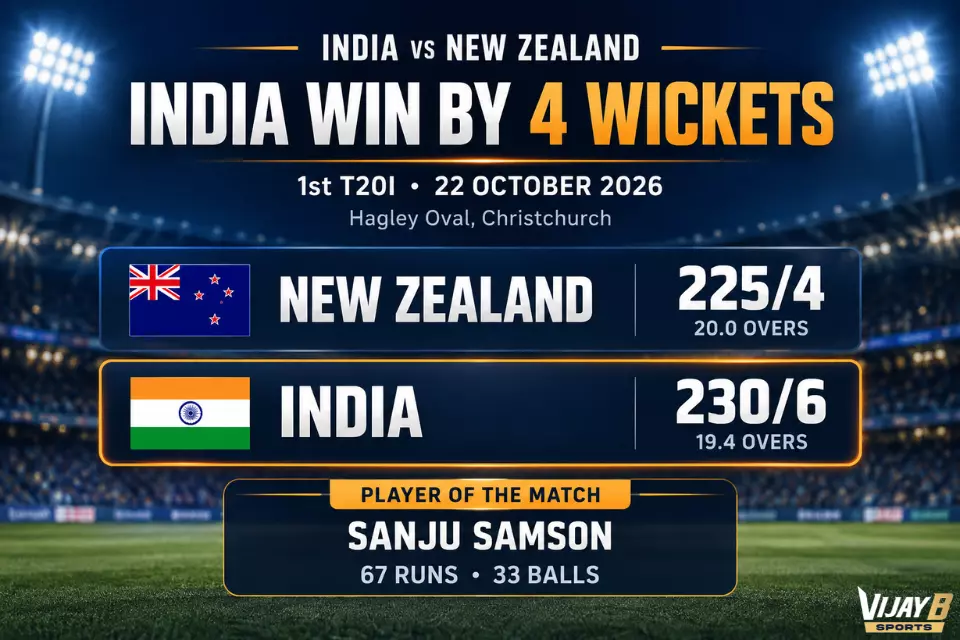
New Zealand posted 225/4 in 20 overs, but India chased down the 226-run target to finish on 230/6 in 19.4 overs, winning by four wickets with two balls to spare. Sanju Samson scored 67 off 33 balls, while Naman Dhir’s unbeaten 42 off 15 deliveries sealed India’s record T20I chase.
| Team | Score | Overs |
| New Zealand | 225/4 | 20.0 |
| India | 230/6 | 19.4 |
Result: India won by 4 wickets.
Player of the Match: Sanju Samson — 67 runs off 33 balls.
Glenn Phillips Gives New Zealand a Strong Total
New Zealand posted 225/4, with Glenn Phillips leading the way through an unbeaten 82 off 40 balls. His innings left India needing to score at more than 11 runs an over from the start.
A target of that size creates pressure well before the closing overs. A quiet spell can quickly push the required rate higher, but attacking every delivery brings its own risk.
For India, the challenge was to keep scoring without allowing a few wickets to bring the innings to a halt. One big individual performance could provide a platform, but completing the chase would require contributions across the batting order.
That balance is especially important in a high-scoring T20I. Batters need to find boundaries while also making sure the deliveries between those boundaries produce runs.
Samson’s Fast Start Gives India Early Momentum
Samson scored 67 off 33 balls to give India a strong foundation. However, New Zealand fought back through spin, reducing the visitors from 93 without loss to 122/4.
The shift showed how quickly a T20 chase can change. A comfortable position can become difficult within a few overs, particularly when new batters arrive with the required rate still demanding immediate action.
Samson’s early scoring had given India some breathing room. Once wickets started falling, the task changed from maintaining momentum to rebuilding it.
Incoming batters had little time to settle. They needed to assess the bowling, rotate the strike and identify scoring opportunities without allowing the pressure to grow.
For New Zealand, those breakthroughs created an opening. Taking wickets in the middle overs offered a way to disrupt India’s rhythm even after an expensive start.
India’s Middle Order Keeps the Chase Alive
Shreyas Iyer and Axar Patel helped India stay in the contest after the loss of quick wickets. Their contributions kept the target within reach and gave the lower order a chance to finish the job.
This phase was an important part of the chase. Opening batters can attack with the full innings ahead of them, while middle-order players often have to adjust immediately to a more complicated situation.
They must weigh the runs required against the balls remaining and the wickets available. Playing too cautiously can leave an unrealistic task at the end, while taking excessive risks can expose the lower order too early.
India’s recovery helped prevent either outcome from deciding the match. The chase remained difficult, but it stayed alive long enough for another attacking innings to make the difference.
That is the value of batting depth: a setback does not have to end the team’s chances if the next partnership can keep the scoreboard moving.
Naman Dhir Produces the Match-Winning Finish
Dhir made an unbeaten 42 off just 15 balls and sealed the victory with a six. While Samson had shaped the opening stages, Dhir supplied the acceleration India needed at the finish.
Finishing a chase demands a different kind of judgement. With few deliveries remaining, there is limited room to recover from a quiet over or a missed scoring opportunity.
The batter must respond to the immediate equation. A boundary can bring the required rate down sharply, while a couple of dot balls can hand the advantage back to the bowling side.
Dhir’s innings supplied the decisive late burst. Viewed across the full chase, India’s victory came through several connected efforts: an aggressive start, a recovery after wickets and a successful finish under pressure.
The record belonged to the team, even though the final moments centred on one batter.
India vs New Zealand T20I Series Schedule
After the opening match, the series continues in Christchurch before moving to Wellington, Auckland and Hamilton.
| Match | Date | Venue | Result |
| 1st T20I | 22 October 2026 | Hagley Oval, Christchurch | India won by 4 wickets |
| 2nd T20I | 24 October 2026 | Christchurch | Upcoming |
| 3rd T20I | 27 October 2026 | Wellington | Upcoming |
| 4th T20I | 30 October 2026 | Auckland | Upcoming |
| 5th T20I | 1 November 2026 | Hamilton | Upcoming |
What to Watch in the Next Match
India head into the second T20I with the series lead, although their middle-overs collapse gives them something to address. A strong start provided the platform for victory, but maintaining that momentum would make future chases less demanding.
For New Zealand, the next challenge is turning a strong batting performance into a successful defence. Their spin attack brought them back into the opener, but India still found enough runs in the closing stages.
Follow vijaybsport for more India vs New Zealand updates, match previews and cricket news as the T20I series continues.