
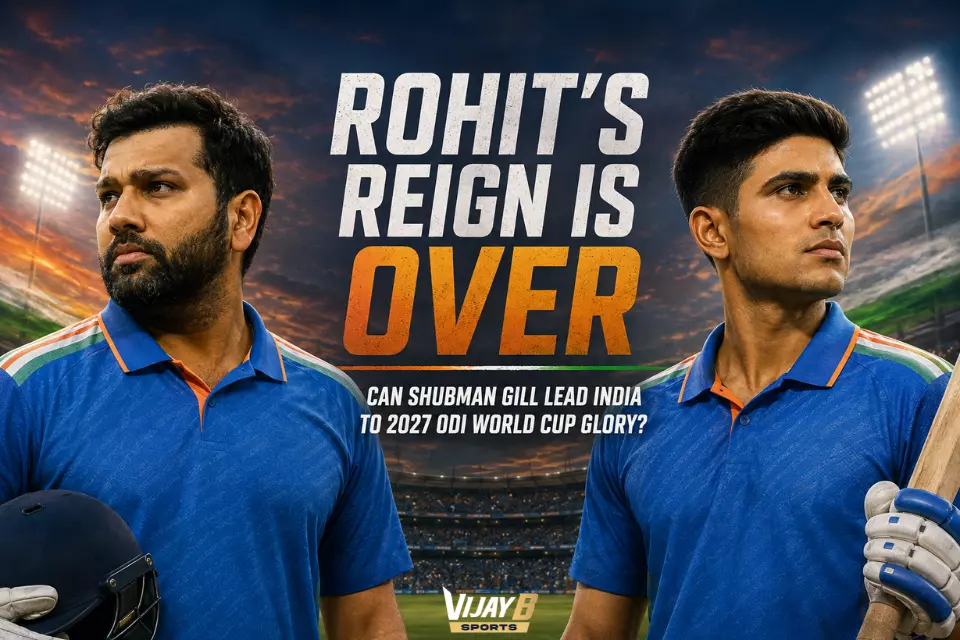
Indian cricket has entered the post-Rohit Sharma era, but this transition involves much more than appointing a new captain.
Rohit gave India three things at the same time: aggressive starts, calm leadership and experience in major tournaments. His approach during the Powerplay often changed the direction of a match before the middle overs had even begun. As captain, he also managed his bowlers and backed players through difficult periods.
Shubman Gill has now taken over the ODI captaincy, but India must redistribute the responsibilities Rohit carried. Gill is the clear favourite to lead the Men in Blue at the 2027 ODI World Cup, while Yashasvi Jaiswal, Shreyas Iyer, KL Rahul and Rishabh Pant are among the players competing for places in the new batting core.
Gill’s Road to the 2027 ODI World Cup
Gill replaced Rohit as India’s ODI captain in October 2025 and has since become the central figure in the team’s next World Cup cycle. His age, batting quality and leadership experience make him the clear favourite for 2027, but the BCCI has not guaranteed that the current arrangement will remain unchanged until the tournament.
Gill must continue scoring runs while showing that he can manage his bowlers, control difficult matches and build a settled team.
Why Gill Leads the Race but Still Faces Questions
Gill will be in the prime of his career in 2027 and is already an established top-order batter. India can therefore build around a captain who earns his place through batting rather than leadership status alone.
His experience of leading India in Tests and ODIs also gives him time to develop his own methods before the World Cup. The larger question is whether captaincy will affect his approach at the top of the order. India need Gill to bat with responsibility without becoming overly cautious during the Powerplay.
Every ODI series before the tournament will test more than his batting form. His bowling changes, field settings and response to pressure will determine whether he can establish enough authority to lead India on the biggest stage.
Gambhir and the Selectors Are Still Testing India’s Core
Head coach Gautam Gambhir and the selection committee have used bilateral series to test different combinations and give younger players international exposure. The rotation has not always produced a settled ODI side, but it has helped India assess their bench strength well before the World Cup.
The BCCI has not confirmed that every selection decision belongs to one fixed 2027 plan. Still, the direction is clear: India want players who can handle different roles instead of waiting until the final months to settle the squad.
The experiments must eventually produce a clear first-choice core. Too much rotation close to the tournament could leave Gill with several options but no settled combination.
One Last Dance for Rohit and Kohli?
The captaincy transition does not mean Rohit has completely left India’s ODI plans. Rohit and Virat Kohli remain available in the 50-over format, but neither has been guaranteed a place in the final World Cup squad.
Their selection will depend on form, fitness and whether their experience still provides something India’s younger batters cannot offer.
Rohit Must Prove His Value as a Specialist Batter
Rohit’s contribution was previously measured through both batting and captaincy. Now that he has handed over the leadership, the selectors can assess him more directly as a specialist opener.
If he can still dominate the Powerplay and produce substantial innings, his attacking ability will remain difficult to replace. Few Indian batters can put an elite new-ball attack under immediate pressure without turning every shot into a high-risk option.
However, if his fitness, match rhythm or performance against pace and bounce declines, India may give Yashasvi Jaiswal more opportunities alongside Gill. Rohit has not been ruled out, but his place will have to be earned through performances rather than his previous captaincy record.
Kohli Still Offers Something India Cannot Easily Replace
Kohli’s role is different. If selected, he is likely to continue as a top-three batter responsible for managing chases, rotating the strike and rebuilding after early wickets.
India have several young players capable of hitting boundaries. What is harder to find is a batter who can control the required run rate, absorb pressure and take a difficult chase into the final ten overs.
That experience could remain valuable in knockout cricket. Still, past achievements alone cannot decide Kohli’s 2027 place. With fewer international matches available to him, every ODI series will carry greater importance.
India do not have to choose between experience and youth immediately. The final decision should depend on whether Rohit and Kohli continue to offer clearly defined roles that younger players cannot yet provide.
Who Can Replace Rohit in the Powerplay?
One of the biggest gaps Rohit may leave is his attacking intent during the first ten overs. India do not only need another opener; they need someone willing to use the fielding restrictions and challenge the opposition’s new-ball bowlers.
Jaiswal is the leading candidate, but India still need to determine how his aggressive style would work alongside Gill.
Jaiswal Is the Leading Candidate
Jaiswal’s left-handed batting gives India a different angle at the top. He is comfortable attacking pace and can use the fielding restrictions to score quickly during the Powerplay.
A left-right opening combination would also force opponents to adjust their bowling lines and field placements more frequently. In theory, Jaiswal could provide early aggression while Gill controls the innings from the other end.
However, success in Tests and T20 cricket does not automatically guarantee the same results in ODIs. Jaiswal must show that he can balance aggression with the concentration required to build a longer innings.
Gill and Jaiswal Must Find the Right Balance
When Gill opened with Rohit, the former captain usually took responsibility for the early attack. That allowed Gill to shape his innings according to the tempo established at the other end.
If Gill partners Jaiswal, he will become the senior member of the opening pair. He must know when to stabilise the innings, when to accelerate and how to help a less experienced partner handle difficult conditions.
The partnership cannot be judged only by batting average. India must also consider scoring rate, left-right balance and performance against swing, seam movement and short-pitched bowling. Replacing Rohit does not require someone who plays exactly like him; it requires a combination that can reproduce the pressure he created.
Gill and Iyer: India’s New Batting Core
A good opening partnership is only the first part of an ODI innings. India also need batters who can control overs 11 to 40, keep the scoreboard moving and avoid losing wickets in clusters.
Gill and Shreyas Iyer are likely to be central to this structure. Iyer’s middle-order role and vice-captaincy also make him an important tactical support for Gill.
Iyer’s Ability Against Spin Will Be Important
Iyer can rotate the strike, use his footwork against spin and punish loose deliveries during the middle overs. These qualities become particularly valuable when opponents try to slow the scoring rate after the Powerplay.
His role could become even more important against teams with strong spin attacks. However, opponents are also likely to test him with short-pitched bowling, especially on surfaces offering pace and bounce.
If Kohli remains at No.3, Iyer is likely to continue at No.4. If Kohli is unavailable, India may need to reconsider the structure of the entire top order. Testing these alternatives before the World Cup will help prevent a late reshuffle.
India Still Need a Change-of-Pace Batter
Gill, Kohli, Iyer and KL Rahul can all stabilise an innings, but selecting too many similar batters could make India overly dependent on the final ten overs for acceleration.
The batting order needs at least one player who can change the tempo before the opposition gains control. That is why Jaiswal, Rishabh Pant and power-hitting all-rounders remain important to the final combination.
A World Cup batting order cannot be selected only on averages. It also needs players who can force the opposition to change its plans.
Who Completes India’s Batting Order?
Several places in India’s middle and lower order remain open, including the wicketkeeper-batter and seam-bowling all-rounder positions.
These choices will determine whether India can turn a stable start into a match-winning total without weakening the bowling attack.
Rahul or Pant: Stability Versus Aggression
KL Rahul offers experience, wicketkeeping and the ability to rebuild after a top-order collapse. He can adjust his tempo according to the match situation, making him a useful option when India need stability.
Pant provides a different threat. His left-handed batting, unconventional shots and willingness to attack spin can change a match in a short period. The trade-off is that his approach may produce less consistent results.
The decision should depend on the rest of the batting order. If India already have several players who prefer to build an innings, Pant’s aggression may be more valuable. If the top order becomes younger and more attacking, Rahul’s calmness could provide better balance.
A Seam-Bowling All-Rounder Can Transform the Balance
A fit Hardik Pandya remains one of India’s most valuable white-ball options. He can provide lower-order power and additional seam bowling, giving Gill a fifth or sixth bowler without shortening the batting order.
Young all-rounders such as Nitish Kumar Reddy may also remain under consideration, but they must prove that they can bowl a reliable number of overs rather than serving only as occasional options.
A dependable seam-bowling all-rounder would give India greater flexibility, especially when conditions favour an extra fast bowler.
How Will African Conditions and the Super 7 Test Gill?
The World Cup will be played across South Africa, Zimbabwe and Namibia. Conditions will vary between venues, so India cannot prepare as if every match will take place on the same type of fast, bouncy surface.
Gill must have enough options to adjust his XI according to the ground, weather and opposition. The new Super 7 format will also place additional pressure on squad depth and tactical planning.
Pace Depth and Fitness Will Matter in Africa
Some South African venues can offer pace, bounce and new-ball movement. India will therefore need different types of fast bowlers rather than selecting only on raw speed.
Control, seam movement and death-over variations will remain just as important. India are also unlikely to abandon spin, as a wicket-taking option such as Kuldeep Yadav can still influence the middle overs.
Fitness will be another major factor. The workloads of Jasprit Bumrah, Hardik and other multi-format players must be managed carefully, but no plan can guarantee an injury-free squad. India need a reliable second group of bowlers capable of replacing the first-choice attack without significantly weakening the side.
The Super 7 Does Not Allow India to Start Slowly
India must first progress from a six-team group before reaching the Super 7, where the top four sides will advance to the semi-finals.
Each team will play only five matches in the main group stage, so one defeat or a poor Net Run Rate could become costly. Once India reach the Super 7, the longer round-robin stage will reward squad depth but also increase the demands on player fitness.
Gill will have to think beyond simply winning. He must know when to push for a larger margin, when to rest key players and how to keep the squad competitive throughout the tournament.
Replacing Rohit Requires an Entire Team
Shubman Gill is currently the leading candidate to captain India at the 2027 ODI World Cup, but replacing Rohit Sharma will require more than naming a new skipper. Jaiswal may take over the Powerplay aggression, Gill can control the opening phase, Iyer can manage the middle overs, and Rahul or Pant can provide wicketkeeping and lower-order support. A fit seam-bowling all-rounder would give the side the balance needed for Southern African conditions.
The availability of Rohit and Kohli will still shape the final batting order, as India must balance their experience against opportunities for the next generation. The post-Rohit era has already begun, and India’s title chances will depend on whether they can turn a change of captain into a complete team transition.
👉Follow vijaybsports for the latest updates on India’s 2027 ODI World Cup squad, Gill’s captaincy, the futures of Rohit and Kohli, player injuries and tournament developments.

FAQs About India at the 2027 ODI World Cup
A:No official announcement has ruled Rohit out. He is no longer the ODI captain, but he can still compete for a place as a specialist opener. His selection will depend on form, fitness and the development of India’s younger opening options.
A:Gill is the current ODI captain and the leading candidate, but the BCCI has not announced India’s final World Cup squad. His results, fitness and leadership performances before the tournament will remain important.
A:Jaiswal is one of the leading candidates. His left-handed batting and Powerplay aggression fit India’s requirements, but he still needs more ODI experience and time to build a stable partnership with Gill.
A:If Kohli remains fit and is selected, he is likely to continue as a top-three batter. His responsibilities would include controlling the innings, managing chases and supporting India’s younger leadership group. His place, however, is not officially guaranteed.
A:India’s squad depth could be useful during a longer tournament, but the format still carries risks. Teams will have only five matches in the second round, where wins and Net Run Rate may decide qualification. Fitness, tactical flexibility and squad rotation will become even more important in the Super 7.