
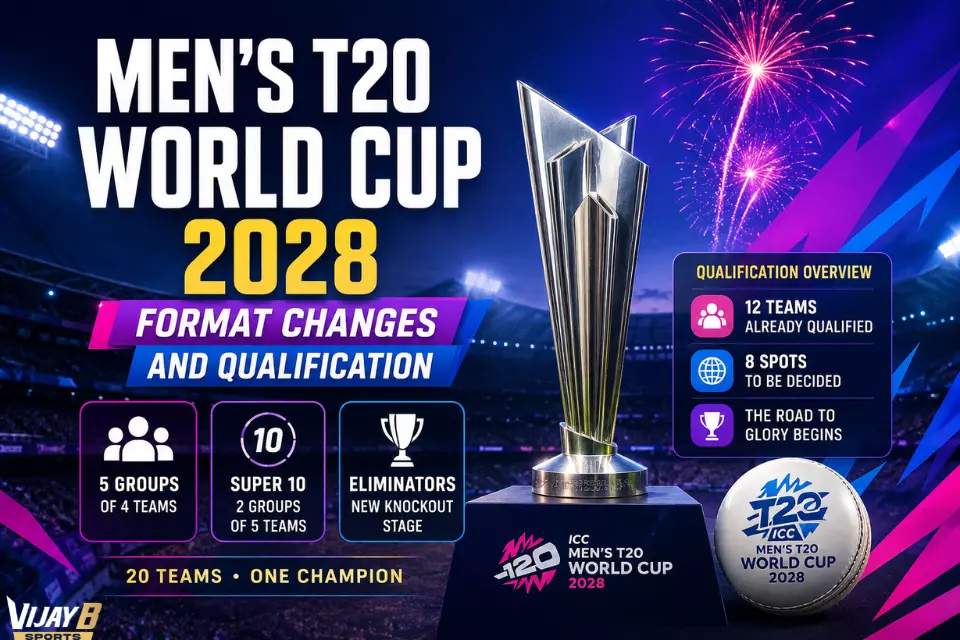
The ICC Men’s T20 World Cup will introduce a completely new tournament structure in 2028. Instead of continuing with the Super 8 stage used in recent editions, the competition will feature a Super 10 phase and a brand-new Eliminator round, creating a longer and more competitive road to the title.
The revised format changes every stage of the tournament, from the opening group matches to the knockout rounds. With 20 teams competing and a different qualification pathway, the 2028 edition promises more high-stakes matches and greater opportunities for emerging cricket nations.
The Group Stage Will Feature Five Groups of Four
The opening stage of the tournament will feature 20 teams divided into five groups of four. Every team will play three group matches, with only the top two teams from each group progressing to the Super 10.
Group Stage format
- 20 teams divided into 5 groups of 4
- Each team plays 3 matches
- The top two teams from each group qualify for the Super 10
- 10 teams advance to the next stage
With only three matches to earn points, there is little room for error. A single defeat could force teams to rely on net run rate or other results to stay in contention, making every game important from the opening day.
For emerging nations, the smaller groups also create more opportunities to produce major upsets. One unexpected result could dramatically change the standings and put tournament favourites under immediate pressure.
Super 10 Replaces the Super 8
After the group stage, the remaining ten teams will move into the newly introduced Super 10. They will be divided into two groups of five, with every team playing four additional matches.
Super 10 format
- 10 qualified teams
- Split into 2 groups of 5
- Every team plays 4 matches
- Group winners advance directly to the semi-finals
Compared with the previous Super 8 system, the Super 10 creates more matches between teams that have already proved themselves during the opening stage. Every result carries greater significance because it directly affects qualification for the knockout rounds.
Eliminators Add Another Knockout Challenge
One of the biggest changes to the tournament is the introduction of the Eliminator round. Instead of only rewarding the top two teams in each Super 10 group, four teams will continue their journey towards the championship.
How the Eliminators work
- 2nd place in Super 10 Group A vs 3rd place in Super 10 Group B
- 2nd place in Super 10 Group B vs 3rd place in Super 10 Group A
- The two winners advance to the semi-finals
- Super 10 group winners qualify directly for the semi-finals
This format places greater value on finishing first. Teams that top their Super 10 group avoid an additional knockout match, while those finishing second or third must survive one more elimination game to reach the final four.
Which Teams Have Already Qualified for 2028?
Twelve teams have already secured their places at the 2028 Men’s T20 World Cup through a combination of host status, their performance at the 2026 tournament and the latest ICC Men’s T20I Team Rankings.
| Qualification Category | Teams |
| Co-hosts | Australia, New Zealand |
| Qualified through the 2026 Men’s T20 World Cup and ICC Men’s T20I Team Rankings | Afghanistan, Bangladesh, England, India, Ireland, Pakistan, South Africa, Sri Lanka, West Indies, Zimbabwe |
| Total teams already qualified | 12 teams |
The confirmed field already features many of the strongest T20 nations in international cricket. However, the tournament lineup is not yet complete, with eight qualification places still available.
How Will the Remaining Teams Qualify?
The remaining eight places will be decided through the ICC’s regional qualification pathway, giving Associate Members another opportunity to compete on cricket’s biggest stage.
| Regional Qualifier | Qualification Places |
| Africa | 2 |
| Asia–East Asia Pacific | 3 |
| Europe | 2 |
| Americas | 1 |
| Total | 8 |
Each regional tournament will determine which teams complete the 20-team field. The qualification system continues to reward strong performances from Associate Members while ensuring representation from every major cricket region.
Why the New Format Matters
The Men’s T20 World Cup has continued to evolve as international cricket expands around the world. The 2024 and 2026 editions used four groups of five teams followed by a Super 8 stage, with the top two teams from each Super 8 group progressing directly to the semi-finals.
The 2028 tournament introduces a different balance. Smaller opening groups increase the importance of every early result, while the Super 10 guarantees more matches between teams that have already progressed through the first phase. The addition of Eliminators also rewards teams that finish first instead of simply qualifying for the next round.
Rather than placing all the emphasis on reaching the second stage, the new format makes every position in the Super 10 meaningful. Every point, every net run rate calculation and every victory could influence a team’s path to the championship.
Final Thoughts
The 2028 ICC Men’s T20 World Cup introduces one of the biggest format changes in the tournament’s history. From the five-group opening stage to the Super 10 and the new Eliminator round, every phase has been designed to create more competitive cricket and higher stakes throughout the competition.
For players, consistency will become more important than ever. For fans, the new structure promises more meaningful contests between the world’s leading T20 teams while giving emerging nations a genuine opportunity to qualify and make an impact on the global stage.
Stay tuned to vijaybsports for the latest ICC tournament news, qualification updates and comprehensive coverage of the road to the Men’s T20 World Cup 2028.

FAQ
A: A total of 20 teams will participate in the tournament.
A: The Super 10 features 10 teams divided into two groups of five. Each team plays four matches, with the group winners advancing directly to the semi-finals.
A: Teams finishing second and third in each Super 10 group play cross-over Eliminator matches. The winners qualify for the semi-finals.
A: The top two teams from each of the five groups progress to the Super 10, meaning 10 teams advance from the opening stage.
A: The final eight places are decided through ICC regional qualification tournaments across Africa, Asia–East Asia Pacific, Europe and the Americas.