

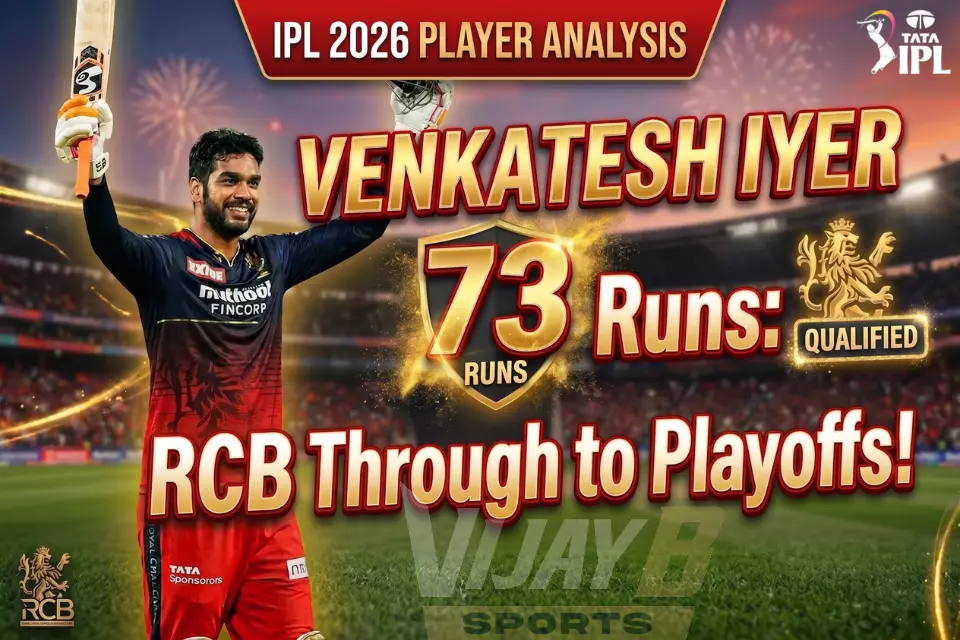
On May 17, 2026, the Himachal Pradesh Cricket Association Stadium in Dharamsala witnessed one of Royal Challengers Bengaluru’s most important victories of IPL 2026.
In Match 61 against Punjab Kings, RCB posted a massive 222/4 before restricting PBKS to 199/8, sealing a 23-run win and confirming their place in the playoffs. While the scoreboard reflected a complete team performance, the real turning point came from Venkatesh Iyer, whose unbeaten 73* off 40 balls became the defining innings of the match.
More than just a powerful knock, this IPL 2026 Player Analysis highlights Iyer’s value as a flexible middle-order batter. With RCB needing control and acceleration at the same time, he delivered both, turning a high-pressure opportunity into a playoff-clinching statement.
The Numbers: A Knock That Changed the Match
Venkatesh Iyer walked in at a crucial stage after Devdutt Padikkal’s dismissal at 97/2 in 9.1 overs. RCB had a strong platform, but Punjab Kings still had a chance to slow the scoring rate through the middle overs. Instead, Iyer took control of the innings and pushed RCB toward a match-winning total.
Venkatesh Iyer – Match Figures
- Runs: 73*
- Balls: 40
- Fours: 8
- Sixes: 4
- Strike Rate: 182.50
- Result: RCB won by 23 runs
- Award: Player of the Match
His innings was not just about boundary-hitting. It was about timing the acceleration perfectly. Iyer started with control, allowed Virat Kohli to continue anchoring the innings, and then attacked once he found his rhythm.
This was exactly the kind of middle-order performance RCB needed before entering the playoffs.
Middle-Overs Control: Where Iyer Took Over
The decisive phase came between overs 10 and 16, when RCB needed to turn a good start into a dominant total.
Calm Entry Under Pressure
When Iyer came in, RCB were already scoring well, but Punjab Kings still had an opening. A couple of quick wickets could have pulled the innings back. Iyer avoided unnecessary risks early, rotated the strike, and gave himself enough time to read the pace of the surface.
That calm start was important because it prevented PBKS from building pressure after Padikkal’s wicket.
The Kohli-Iyer Partnership
The partnership between Virat Kohli and Venkatesh Iyer became the core of RCB’s innings. Kohli scored 58 off 37 balls, while Iyer supplied the stronger attacking push from the other end. Together, they helped RCB move from a strong position into a commanding one.
This partnership worked because both batters played different roles. Kohli gave the innings structure, while Iyer targeted loose deliveries and lifted the run rate. By the time Kohli departed, RCB were already in position to push beyond 200.
Acceleration at the Right Time
Once set, Iyer shifted gears quickly. He punished anything short or wide, used his reach well against spin, and attacked the boundary options with confidence. His eight fours and four sixes showed how effectively he converted scoring opportunities into momentum.
This was not reckless hitting. It was controlled aggression.
Tactical Impact: Why This Knock Matters for RCB
RCB’s batting strength has been built around experienced top-order control and finishing power, but knockout cricket often demands more than a fixed batting plan. Teams need flexibility, especially when pressure situations force players into different roles, and Iyer’s 73* proved that he can be trusted at No.4.
As a left-handed batter, Iyer also gives RCB better balance in the middle overs, particularly against spin and matchup-based bowling plans. His ability to start carefully, build a partnership, and then finish unbeaten makes him more than just a power-hitter. He provides a valuable bridge between the top order and the finishers, which could become extremely important as RCB move deeper into the playoff
Match Impact: RCB Turn Scoreboard Pressure Into Victory
RCB’s total of 222/4 placed immediate pressure on Punjab Kings. Chasing 223 required PBKS to attack from the start, but early wickets damaged their momentum. Even though Shashank Singh fought back with a half-century, PBKS eventually finished at 199/8, falling short by 23 runs.
This result was bigger than just two points. It confirmed RCB’s qualification for the IPL 2026 playoffs and strengthened their momentum at the most important stage of the league phase.
For PBKS, the defeat was costly. Their bowlers could not contain RCB’s middle and death overs, and the batting lineup was left chasing a target that always looked difficult after the early setbacks.
Season Impact: Iyer Adds Depth Before the Playoffs
Every successful playoff team needs players who can step up beyond their usual role. That is what made this innings so important for RCB.
Venkatesh Iyer had not always been the central figure in RCB’s batting order this season, but this match changed the conversation. His unbeaten 73 showed that he can handle pressure, adapt to the team’s needs, and produce a high-impact innings when the stakes are high.
For RCB, this means their batting lineup now looks even deeper. With Kohli providing consistency, Tim David offering finishing power, and Iyer finding form at No.4, RCB have another dangerous option heading into the knockout stage.
Conclusion: The Rise of Venkatesh Iyer in RCB’s Middle Order
To summarize, this IPL 2026 Player Analysis highlights how Venkatesh Iyer turned one major opportunity into a playoff-clinching statement.
His 73* off 40 balls was more than a strong individual score. It shaped RCB’s innings, gave the team control through the middle overs, and helped set up a match-winning total. In a high-pressure clash against Punjab Kings, Iyer showed the exact qualities RCB will need in the playoffs: composure, power, timing, and tactical awareness.
As Royal Challengers Bengaluru move into the knockout stage, Iyer’s form could become a major weapon. If he continues to bat with this level of control and aggression, RCB’s middle order will look even more dangerous in the final stretch of IPL 2026.
Follow vijaybsport for real-time match insights, expert analysis, and winning strategies that keep you closer to every major moment of the season.