
🌧 A Rainy End, but a Clear Result for Cricket India
It wasn’t the grand finish fans expected, but it was enough for cricket India to celebrate a series win.
The final T20I at the Gabba in Brisbane was washed out after heavy rain and lightning, ending India’s tour of Australia with a 2–1 victory in the five-match series.
Before the skies opened, India had started brilliantly — 52 without loss in just 4.5 overs.
Shubman Gill looked in glorious touch, smashing 29* off 16 balls, while Abhishek Sharma stood steady at 23* off 12.
Then came the thunder, lightning, and rain that refused to stop.
Match abandoned.
Series result: India 2–1 Australia.
The vijaybsport headline summed it up perfectly:
“Sometimes, you don’t need fireworks to prove dominance — calm consistency wins the series.”
🏆 A Journey from Canberra to the Gabba — India’s Complete Series
This result might have come under the clouds, but the story was built under pressure and patience.
The series began the same way it ended — with rain. The opener in Canberra was washed out without a ball bowled.
Australia bounced back strongly in the second T20I at the MCG, dominating in front of 82,000 fans thanks to Josh Hazlewood’s fiery spell.
But then came India’s turnaround — on two slower pitches at Hobart and the Gold Coast, where spin became the weapon and the rhythm returned.
From Axar Patel’s precision to Washington Sundar’s control and Shivam Dube’s double-strike at the Gold Coast, India found their trademark composure again.
By the time they reached Brisbane, the team wasn’t just hoping to win — they were playing like a unit that already knew how to win.
Even though the final ended without a ball after 4.5 overs, the message was clear:
cricket India can adapt to any pitch, any condition, and any weather.
🧠 Suryakumar’s Reflection: “This Was Teamwork, Not Luck”
After the trophy presentation, Indian captain Suryakumar Yadav said what every fan was thinking:
“Every player contributed in every match. This win is a total team effort — in batting, bowling, and fielding. Everyone knew their role and trusted each other.”
He also spoke about finding inspiration at home.“I saw how our women’s team lifted the World Cup in India — the energy, the support, the love from fans. Playing at home brings pressure, yes, but it also brings unbelievable motivation.”
Vijaybsport analysts echoed his words in their post-match report:
“The spirit of cricket India isn’t about the scoreboard — it’s about rhythm. This team has learned how to control rhythm better than anyone.”
⚡ The Gabba Start That Promised Fireworks
When Marsh won the toss and sent India in, all eyes were on how the openers would handle the Gabba’s lively surface — known for its bounce, pace, and carry.
It didn’t take long to find out.
Abhishek Sharma sent the fourth ball of the match racing past midwicket for four. Next ball, he mistimed a big shot that went high toward Glenn Maxwell. For a moment, it looked like the end of his innings — but Maxwell dropped it!
Two balls later, Abhishek almost repeated the shot, this time safely clearing the infield. Luck or timing, it didn’t matter — India were racing.
Then came Shubman Gill, looking every bit the class act. In Ben Dwarshuis’ second over, he produced four boundaries — a mix of crisp cuts, straight drives, and that gorgeous cover drive that’s become his signature.
It was the Gill fans had been waiting to see — confident, fluent, and ruthless on anything overpitched.
In just 29 balls, the scoreboard read 52/0.
And then, the clouds rolled in.
Within minutes, the floodlights flickered, thunder echoed across the Gabba stands, and rain poured down like it had been waiting for this cue all night.
The players walked off, never to return.
🇮🇳 The Numbers Behind the Series
| Match | Venue | Result | India’s Key Performers |
| 1st T20I | Canberra | Abandoned (Rain) | — |
| 2nd T20I | Melbourne | Australia won | Hazlewood 3/20 |
| 3rd T20I | Hobart | India won | Axar 2/20, Sundar 3/3 |
| 4th T20I | Gold Coast | India won | Dube 2/20, Axar 2/20 |
| 5th T20I | Brisbane | Abandoned (Rain) | Gill 29*, Abhishek 23* |
This table shows the pattern clearly.
India struggled early in pace-friendly conditions but grew stronger as the series progressed.
By the final, they had an answer for every question — pace, spin, and pressure.
Vijaybsport cricket india coverage highlighted how this series was more about “maturity than magic.”
🎯 The Turning Point of the Tour
Most fans will remember the 4th T20I at the Gold Coast as the real turning point.
That’s where India defended 167 with clinical discipline.
Axar Patel and Washington Sundar’s spin combination frustrated Australia into mistakes, while Shivam Dube’s two wickets in one over sealed the deal.
From that moment, India carried the confidence that they could win anywhere.
And even in Brisbane, before the rain, they proved it again — by mastering a fast track that usually belongs to Australia.
🗣 Marsh’s Reaction: “We’ll Take Lessons, Not Excuses”
Australian captain Mitchell Marsh took the washout with grace.
“I can’t remember the last time we had so much rain interrupting matches. But honestly, there’s plenty of learning for us. We saw where we’re strong and where we need to adapt, especially against quality spin.”
He also praised India’s consistency.
“They played smart cricket. Their spinners and all-rounders know exactly what they’re doing. We’re building our side for the World Cup year — and this series gives us clarity.”
Vijaybsport experts noted that Australia’s middle-order still struggles when the ball grips slightly, something India exploited perfectly in Hobart and Gold Coast.
📊 Cricket India by the Numbers — Why the 2–1 Win Matters
- Economy under pressure: India’s spinners averaged only 6.3 runs per over across the series — better than any visiting side in Australia in the last three years.
- Middle overs mastery: Overs 10–16 — often the deciding phase — India outscored Australia by 45 runs and took 8 wickets in those overs alone.
- Gill’s return to form: Shubman Gill’s strike rate (181.2) across his two innings before rain showed why he remains India’s key for powerplay stability.
- Suryakumar’s leadership: India’s captain used 17 different bowling combinations across 3 completed matches — showing tactical flexibility rare in T20Is.
Each of these metrics tells the same story: cricket India is no longer one-dimensional. They can win with bat, ball, or brain.
🧭 The Bigger Picture — Heading Home as Champions
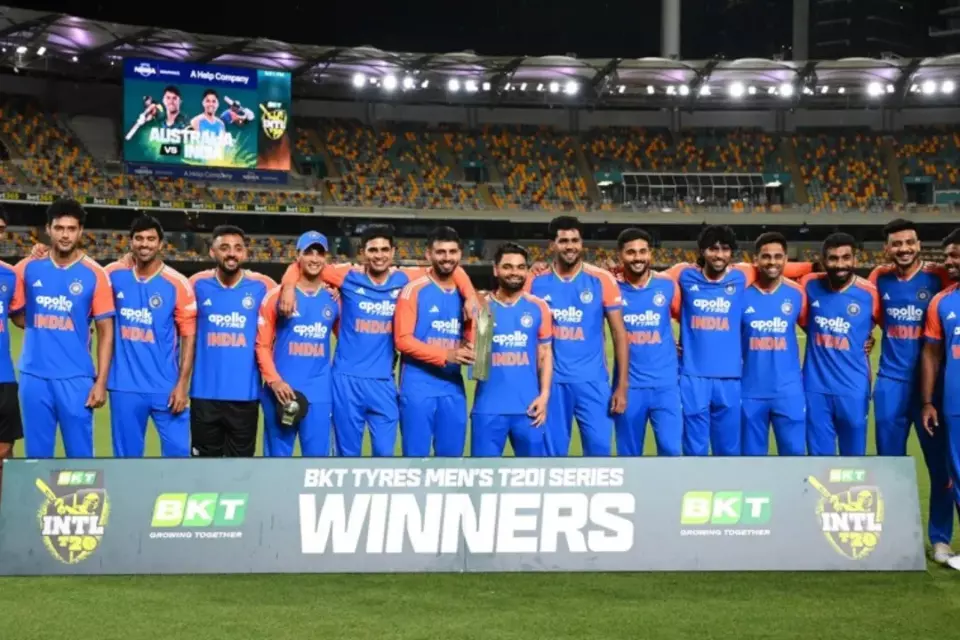
As the team lifted the trophy at the rain-soaked Gabba, smiles said it all.
This wasn’t just about beating Australia; it was about regaining confidence ahead of next year’s T20 World Cup — to be hosted in India.
The photos of the team posing with the trophy, drenched but grinning, flooded vijaybsport social media within minutes.
Fans filled the comments with pride:
“Rain or shine, this team finds a way!”
“Spin + calm + confidence — this is the new India.”
Suryakumar’s men now fly home not just with silverware, but with trust — in each other, and in a formula that works anywhere.
🏠 What’s Next for Cricket India
India’s next stop is the domestic prep camp before the T20 World Cup 2026, hosted on home soil.
Players like Gill, Dube, and Abhishek have strengthened their case for long-term inclusion, while Axar and Sundar look irreplaceable in the spin core.
Vijaybsport predicts that the next year’s focus will be balancing youth and experience — giving young openers time while rotating senior bowlers to avoid burnout.
As the report concluded:
“Cricket India has evolved from a team of talent into a team of temperament.”
📱 Final Word — Rain, Rhythm, and Vijaybsport
Sometimes the scoreboard doesn’t tell the full story.
Yes, the Gabba match was washed out, but it symbolized something much bigger.
India started the series uncertain, adjusted midway, dominated later, and ended unshaken — even against nature itself.
That’s what makes this 2–1 triumph special.
And if you followed it live on vijaybsport, you didn’t just see scores — you saw rhythm, spin trajectories, pressure graphs, and player confidence curves.
You saw how cricket India wins matches not only with skill, but with calm, clarity, and character.
As Suryakumar said at the presentation:
“It’s not about where we play. It’s about how we play together.”Rain stopped the cricket. But it couldn’t stop cricket India.